Created, Captured, Kept · Post 0
Paid Three Ways
Stéphane Guerraz. Framework built with Elsie Chang. [Publication date]
Buying AI software is still a cost-benefit decision. The invoice now shows one of the costs.
[Anchor: Stéphane's witnessed moment goes here.]
Most AI purchases are still run the way software has been bought for twenty years: a price per seat, a benefit per user, a payback period. That method rested on three assumptions. The product was the same for every customer. The price was the whole cost. The data sat in storage.
All three have moved. The buyer now pays in three currencies. Risk, because the result may not arrive and the buyer carries most of the loss if it does not. Money, because the price moves with use and the buyer's own cost of making it work never reaches the invoice. Data, because the software learns from the buyer's corrections and outcomes. Only the price is printed.
Created, captured, kept
This series reads every AI purchase in three parts. What the AI creates for the company that deploys it. What the vendor captures through its price. What anyone keeps once rivals adopt the same tool. Elsie Chang's identity holds the three in one line, with attribution written in:
payoff ≈ value created × attribution × share captured × durability − cost to serve
Three haircuts stand between the value at stake and the value a buyer can bank. Realisation: does the gain reach the P&L? Attribution: can the buyer prove the tool produced it? Durability: does it last once rivals adopt the same tool? What survives all three is the value kept. The price is measured against it.
Each side's payoff is its net value. The vendor's is its captured share of the value kept, less its cost to serve. The buyer's is the rest, less its own cost.
One quote
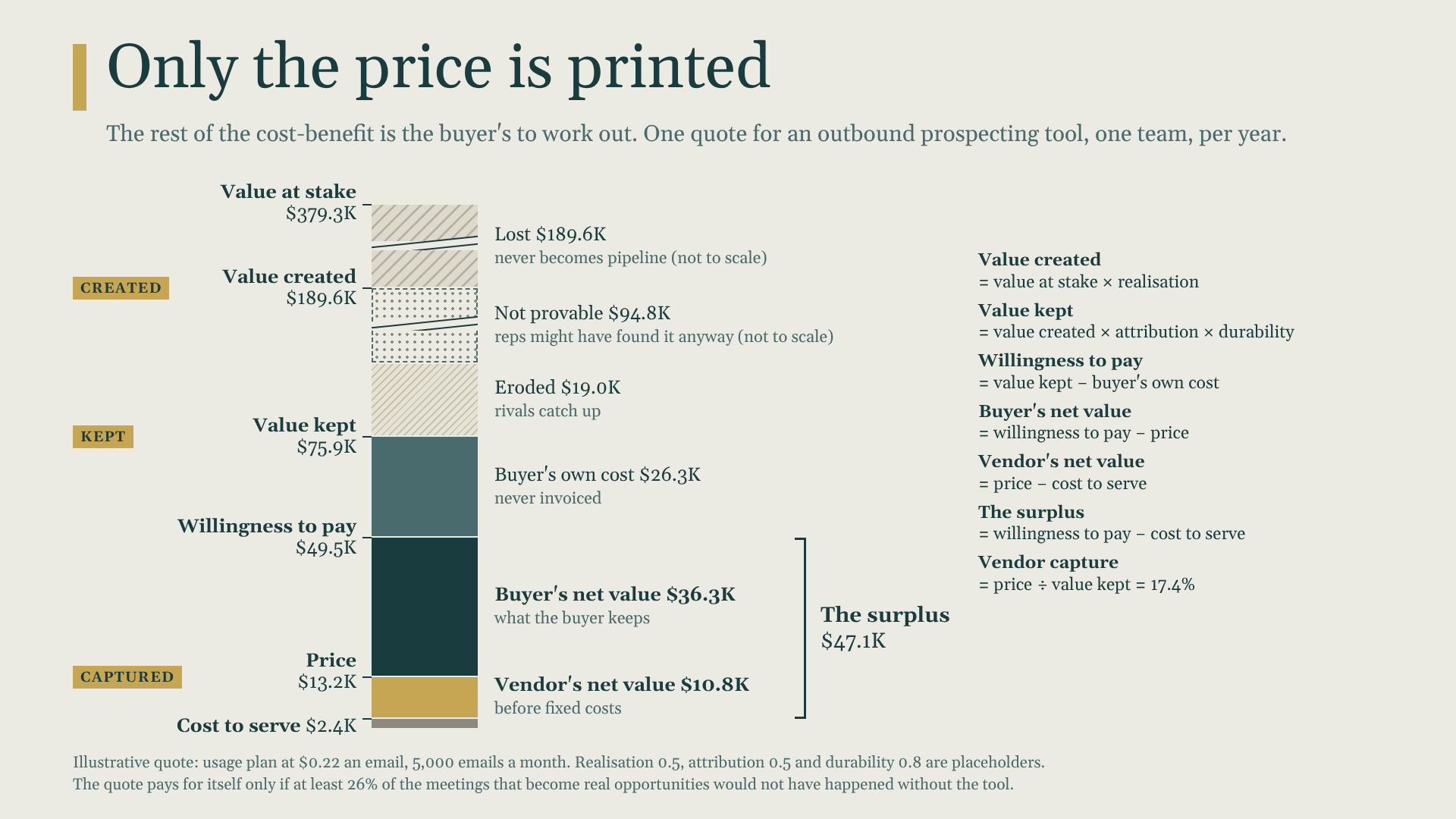
Take an illustrative quote for an outbound prospecting tool: one sales team, one use case, priced by usage at $0.22 an email, run on our placeholder assumptions. Half the meetings it books never become pipeline. Of the pipeline that lands, the buyer can credit half to the tool; the reps might have found the rest anyway. A fifth of what remains erodes as rivals adopt the same tool and the same inboxes tire. What survives is a fifth of the value at stake.
One quote, one team, one use case, per year
| Line | Per year | How |
|---|
| Value at stake | $379.3K | meetings the tool could book, at $3,000 each |
| Value created | $189.6K | × 0.5 realisation |
| Value kept | $75.9K | × 0.5 attribution × 0.8 durability |
| Buyer's own cost | $26.3K | making it work; never invoiced |
| Willingness to pay | $49.5K | value kept − own cost |
| Price | $13.2K | $0.22 × 5,000 emails × 12 months |
| Buyer's net value | $36.3K | willingness to pay − price |
| Cost to serve | $2.4K | the vendor's variable cost, AI included |
| Vendor's net value | $10.8K | price − cost to serve, before fixed costs |
Realisation, attribution, durability, the value of a meeting and both costs are placeholders. The figures describe one use case and do not add up to a company.
The buyer's own cost is twice the price. The vendor captures 17% of the value kept. The quote pays for itself only if at least 26% of the meetings that become real opportunities would not have happened without the tool. On this quote, attribution is the hinge.
Three currencies, three parts
Risk sits on the created side. Customers who looked identical at signing get different results, because the result depends on their data, their people and how the AI model behaves on both. If it fails, the vendor loses a fee. The buyer loses the result and the months. An outcome price would move part of that risk to the vendor, but only where the result can be credited to the AI. We read the public pricing of ten GTM AI vendors on 23 September 2026. None prices its core software on a result in the customer's business, such as a meeting a prospect accepts, a deal that closes or an account that renews. One calls its charge per recommended lead outcome-based. Recommending a lead is a task the software completes. The result, if it comes, comes later.
Money sits on the captured side. Every AI action costs the vendor inference, so one heavy user can cost more than a seat brings in. Vendors have responded by adding usage charges to the seat, priced on what serving the buyer costs them. The buyer also carries a cost that no invoice shows: integration, data preparation, training, the people who run the tool, and the work of proving it paid.
Data sits on the kept side. The software improves on the buyer's corrections and recorded outcomes. Whether that learning stays the buyer's edge or becomes a feature its rivals rent is settled in the terms, rarely on the price page. When an innovation is easy to copy, value goes to whoever holds the scarce complementary asset (Teece, 1986). In AI software, that asset is often the buyer's own judgment joined to its outcomes. The contract decides who holds it.
Four questions
Each part gives the buyer a question, and each question has its moment.
- Is the offer credible? Does the unit invoiced track a result the vendor can claim as its own? Ask before the demo.
- Will the price move? Where does it sit against the vendor's cost to serve and your cheapest alternative, and can the rate behind it change? Ask before the quote.
- What am I giving away? Do your decisions, joined to your outcomes, feed an AI model your rivals rent? Ask before signature.
- Will it pay? What net value is left after the price and your own cost? Ask it twice: before signing, as the share of the gain the tool must earn to break even; before renewal, against a holdout.
The series
Post 1 tours the myths. Part A, Created, sizes the upside honestly and traces one deployment's gain through realisation and attribution. Part B, Captured, asks what AI is priced on: a mix of pricing models, what can and cannot be charged for, the ceiling and the floors, and one vendor's price read in full. Part C, Kept, follows durability: how much of the gain survives once rivals adopt the same tool, and who holds what is left. The series closes on a call, with the triggers that would move it.
The counter-case
The strongest objection is concentration. If the AI labs and the large suites absorb the application layer, there are no rival quotes to compare. Question 2 loses force. Question 3 gains it: the data pool grows, and the clause gets harder to negotiate.
What would prove this wrong
The series' spine is that usage charges follow the vendor's cost to serve. If by 30 September 2027 three or more of the ten vendors we read publish a per-result price for core software on their own pages (per accepted meeting, closed deal or retained account), that reading is wrong. Per-task prices, such as per lead recommended, do not count. We will re-read the same pages on that date.
The fork
A buyer has one more hour to give an AI quote. One side says give it to the price. The usage charge is where money moves, the vendor is the only counterparty at the table, and the price can be negotiated this week. Proof takes a holdout and months. The other side says give it to the proof. In the illustration, the tool must earn back $39.5K: the $13.2K price plus $26.3K of the buyer's own cost. Halving the price trims that by a sixth, so the 26% bar falls only to 22%. A free tool would still need 17%. And each further tenth of the gain the buyer can prove came from the tool adds $15.2K to the value kept: more than the whole price.
Price or proof: where does your next hour go?
Sources
- Chang and Guerraz, GTM AI Pricing Framework v19, including Chang's value capture identity.
- Public pricing pages of ten GTM AI vendors, read 23 September 2026.
- Illustration: the framework's simulator, usage plan at $0.22 an email, 5,000 emails a month, one team, per year. Realisation 0.5, attribution 0.5 and durability 0.8 are placeholders.
- Teece, D. J. (1986). Profiting from technological innovation. Research Policy, 15(6), 285–305.